

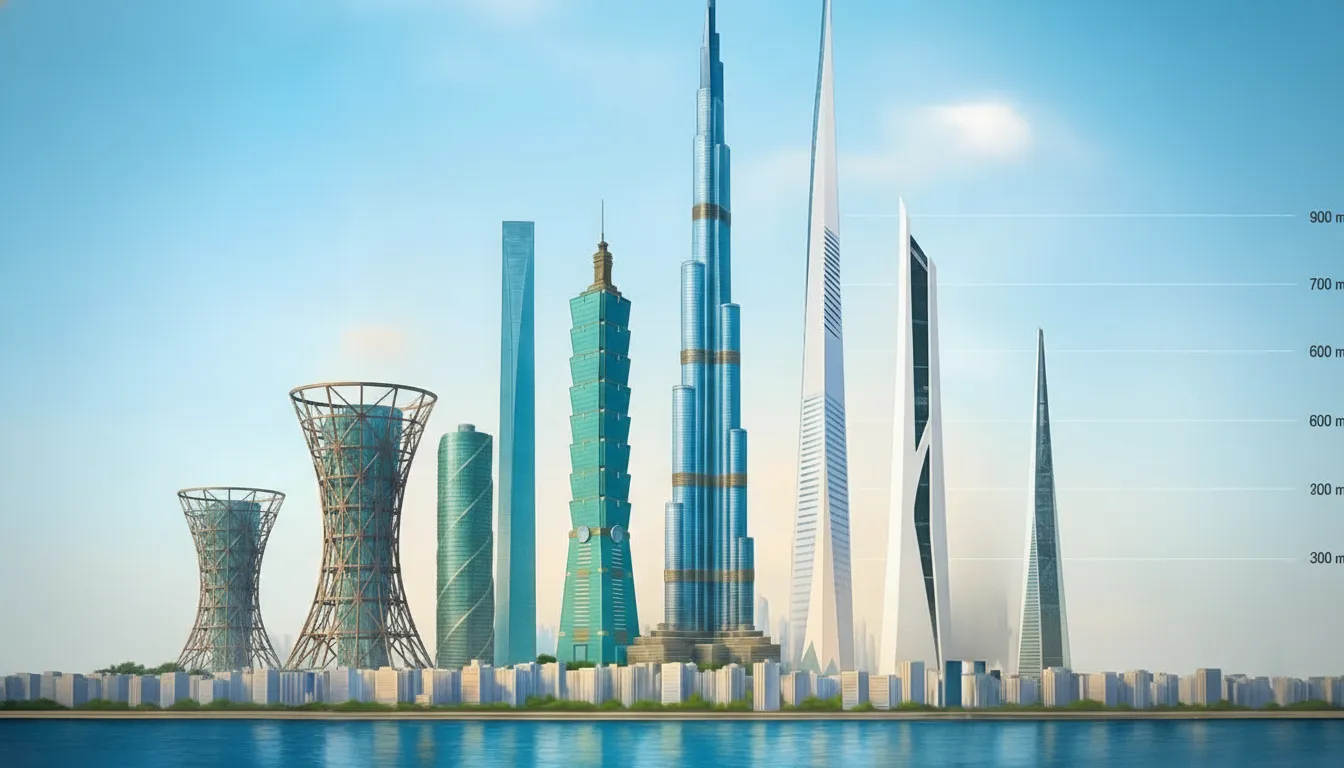
Reaching for the Sky: Exploring the Top 10 Tallest Buildings in the World
The skyline of any major city tells a story. Some stories are about history, others about ambition, and some about human ingenuity. In today’s world, skyscrapers are symbols of economic strength, cultural pride, and architectural brilliance. From Dubai’s iconic desert skyline to the bustling metropolises of China, these towering giants define cityscapes across the globe. Let’s explore the Top 10 Tallest Buildings in the World in 2026, including who owns them, when they were built, their primary uses, and other interesting facts.
1. Burj Khalifa – Dubai, United Arab Emirates
Height & Floors: 828 meters, 163 floors
Completed: 2010
Owner/Developer: Emaar Properties PJSC, founded by Mohamed Alabbar
Uses: Mixed-use – luxury residences, corporate offices, Armani Hotel, retail, restaurants, observation decks
The Burj Khalifa is not just a building; it’s a global icon. Completed in 2010, it remains the tallest structure in the world at 828 meters. Built by Emaar Properties, this tower was designed to put Dubai on the global map. Its Y-shaped floor plan, inspired by Islamic architecture, provides maximum views while ensuring structural stability. The tower hosts luxurious apartments, offices, a hotel designed by Giorgio Armani, and the world-famous At The Top observation decks. Each evening, the Dubai Fountain dances at its base, attracting thousands of visitors.
2. Merdeka 118 – Kuala Lumpur, Malaysia
Height & Floors: 678.9 meters, 118 floors
Completed: 2023
Owner/Developer: PNB Merdeka Ventures Sdn Bhd (under government-linked PNB)
Uses: Offices, hotel, retail, observation decks
Merdeka 118 recently claimed the title of the second tallest building globally. Situated in Kuala Lumpur, it celebrates Malaysia’s independence—“Merdeka” means independence. Owned by the government-linked PNB, this skyscraper is a cultural as well as an architectural landmark. Its design incorporates Malay songket motifs, blending tradition with modernity. Visitors can enjoy offices, luxury hotels, retail spaces, and panoramic views from its observation decks.
3. Shanghai Tower – Shanghai, China
Height & Floors: 632 meters, 128 floors
Completed: 2015
Owner/Developer: Shanghai Tower Construction & Development (government consortium)
Uses: Offices, hotel, retail, observation decks
China’s economic powerhouse, Shanghai, is home to the twisting Shanghai Tower, the tallest building in the country. Standing at 632 meters, its spiral shape reduces wind pressure and enhances energy efficiency. Built by a government consortium, the tower hosts offices, luxury hotels, shopping areas, and one of the highest observation decks in the world. Its LEED-Platinum certification reflects Shanghai’s commitment to sustainable urban development.
4. Makkah Royal Clock Tower – Mecca, Saudi Arabia
Height & Floors: 601 meters, 120 floors
Completed: 2012
Owner/Developer: Government of Saudi Arabia, Ministry of Islamic Affairs
Uses: Hotel, apartments, prayer halls, retail, pilgrimage services
The Makkah Royal Clock Tower is not only a skyscraper but also a spiritual landmark. Located in Mecca, it caters to millions of pilgrims every year. Its clock faces, the largest in the world, are visible from 25 kilometers away. Developed by the Saudi Binladin Group under government oversight, this tower offers hotel rooms, apartments, retail areas, and prayer spaces. It stands as a combination of religious symbolism and modern engineering.
5. Ping An Finance Centre – Shenzhen, China
Height & Floors: 599 meters, 115 floors
Completed: 2017
Owner/Developer: Ping An Life Insurance Company of China
Uses: Offices, hotel, retail, observation decks
Shenzhen’s Ping An Finance Centre is the city’s tallest building and one of the world’s tallest. Owned by Ping An Insurance, it serves as the company headquarters. The tower contains offices, hotels, retail spaces, and observation decks, making it a vertical city. The structure features advanced engineering techniques, allowing it to withstand extreme weather and wind forces.
6. Lotte World Tower – Seoul, South Korea
Height & Floors: 555 meters, 123 floors
Completed: 2017
Owner/Developer: Lotte Property & Development (Lotte Group)
Uses: Offices, residences, hotel, retail, observation decks
South Korea’s pride, Lotte World Tower, is a marvel of modern design. Built by Lotte Group, it houses offices, luxury residences, a hotel, retail areas, and the Seoul Sky observation deck. Its sleek design, inspired by traditional Korean ceramics, offers both aesthetic beauty and functional engineering. The tower has become a cultural hub, hosting exhibitions, events, and panoramic views of Seoul.
7. One World Trade Center – New York City, USA
Height & Floors: 541.3 meters, 104 floors
Completed: 2014
Owner/Developer: Port Authority of New York & New Jersey, Durst Organization (management)
Uses: Offices, observation deck, memorial, commercial
One World Trade Center symbolizes resilience and renewal. Built on the site of the 9/11 attacks, it reaches 1,776 feet to symbolize American independence. Owned by the Port Authority of NY & NJ, this tower contains offices, an observation deck, and memorial spaces. It stands as a beacon of strength, hope, and innovation in Lower Manhattan.
8. Guangzhou CTF Finance Centre – Guangzhou, China
Height & Floors: 530 meters, 111 floors
Completed: 2016
Owner/Developer: Chow Tai Fook Enterprises, New World Development
Uses: Offices, hotel, residences, retail
Owned by Chow Tai Fook Enterprises, the Guangzhou CTF Finance Centre is a modern mixed-use tower combining offices, hotel rooms, apartments, and retail space. It also houses some of the fastest elevators in the world, making it a high-tech marvel in southern China.
9. Tianjin CTF Finance Centre – Tianjin, China
Height & Floors: 530 meters, 97 floors
Completed: 2019
Owner/Developer: Tianjin New World Huan Bo Hai Real Estate Development
Uses: Offices, hotel, serviced apartments
The Tianjin CTF Finance Centre mirrors its southern counterpart in Guangzhou. It provides office space, serviced apartments, and a hotel. Owned by New World Development, it stands as a symbol of northern China’s urban growth and modern architecture.
10. China Zun (CITIC Tower) – Beijing, China
Height & Floors: 527.7 meters, 109 floors
Completed: 2018
Owner/Developer: CITIC Group (state-owned)
Uses: Offices, VIP spaces, observation deck
China Zun, officially the CITIC Tower, is Beijing’s tallest skyscraper. Owned by CITIC Group, it features office spaces, VIP areas, and observation decks. Its shape, inspired by the ancient Chinese Zun vessel, reflects cultural tradition while embracing modern engineering.
Conclusion
The world’s tallest buildings are more than just feats of engineering. They are symbols of human ambition, cultural identity, and economic growth. From Dubai to Beijing, these towers showcase how architecture, technology, and vision converge to create structures that touch the sky.
Whether it’s luxury living, corporate headquarters, observation decks, or religious services, each skyscraper has a unique story, owner, and purpose. As technology advances, the next generation of buildings will surely surpass even these giants, continuing humanity’s quest to reach ever higher.
Frequently Asked Questions (FAQ) – Top 10 Tallest Buildings in the World
1. Which is the tallest building in the world?
The Burj Khalifa in Dubai, United Arab Emirates, is currently the tallest building in the world at 828 meters with 163 floors. It was completed in 2010 and is owned by Emaar Properties.
2. Who owns the tallest buildings?
Ownership varies: some are owned by private companies (like Ping An Finance Centre in Shenzhen by Ping An Group), while others are owned by government or state-linked entities (like Merdeka 118 in Malaysia or Makkah Royal Clock Tower in Saudi Arabia).
3. What are these buildings used for?
Most of the tallest buildings are mixed-use skyscrapers, combining offices, luxury residences, hotels, shopping areas, and observation decks. For example, Burj Khalifa has luxury apartments, corporate offices, a hotel, and an observation deck.
4. When were the top 10 tallest buildings completed?
The completion years range from 2010 (Burj Khalifa) to 2023 (Merdeka 118). Most buildings were completed in the 2010s, reflecting the global boom in skyscraper construction.
5. Can you visit these skyscrapers?
Yes! Many buildings have observation decks open to the public. For example, Burj Khalifa’s “At The Top”, Shanghai Tower’s observation deck, and One World Trade Center’s One World Observatory allow visitors to enjoy panoramic views of their cities.